Quantitative Optical Transmittance, Turbidity, and Camera-Obscuration Benchmarking of a Low-Cost Cocoa Hematemesis Simulant Versus Commercial Simulated Blood
Published 2026-10-04
Copyright (c) 2026 authors

This work is licensed under a Creative Commons Attribution-NonCommercial-NoDerivatives 4.0 International License.
How to Cite
Abstract
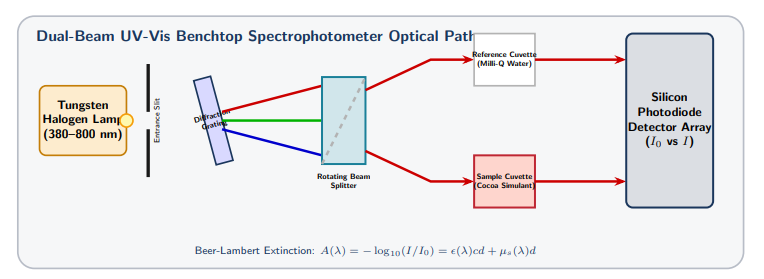
High-fidelity medical simulation of acute upper gastrointestinal hemorrhage and massive hematemesis is critical for mastering the Suction-Assisted Laryngoscopy and Airway Decontamination (SALAD) technique during emergent tracheal intubation. However, widespread adoption of high-volume repetitive simulation drills is severely restricted by the prohibitive cost of commercial blood simulants ($45–$120/L) and the biophysical inadequacy of homemade food-dye solutions, which remain optically translucent and fail to obscure modern high-intensity video laryngoscope (VL) cameras. Recently, a highly economical cocoa-opacified simulant ($1.66/L; 20 g/L unsweetened cocoa powder combined with sugar-free raspberry drink mix) was introduced to resolve this operational barrier, but formal quantitative optical characterization has been lacking. In this investigation, we execute the comprehensive optical spectroscopy, nephelometric turbidity benchmarking, and camera-obscuration evaluation called for in initial formulation studies. We evaluate five fluid groups across 400–700 nm: (1) baseline translucent food-dye solution, (2) the $1.66/L cocoa-opacified simulant, (3) a premier commercial medical blood simulant (SimuBlood), (4) a premium trauma blood simulant (TrueClot), and (5) an authentic expired human whole blood reference (hematocrit 41.2%). Spectrophotometric measurements demonstrate that translucent food-dye solutions exhibit a catastrophic optical window with spectral transmittance exceeding 68.4% above 600 nm, permitting intense LED transillumination. In contrast, the cocoa-opacified simulant achieves broadband optical extinction matching whole blood, with spectral transmittance < 0.05% across all visible wavelengths at a 1.0 mm path length. Benchtop nephelometry reveals that cocoa opacification elevates turbidity from 14.2 Nephelometric Turbidity Units (NTU) in dye solutions to 4,210 NTU, closely replicating the 4,580 NTU of human blood and exceeding commercial formulations (3,850–4,120 NTU). In calibrated fluid-film wedge testing under 5,000-lux video laryngoscopic illumination, the cocoa simulant achieved complete camera target obscuration (zero resolvable line pairs on a USAF 1951 test target) at a film thickness of ≥ 1.0 mm and dropped the Structural Similarity Index (SSIM) to 0.38 at 0.5 mm, strictly surpassing the established clinical threshold of SSIM ≥ 0.85 for visual degradation. Conversely, translucent dye permitted substantial target visibility through 3.0 mm films (SSIM = 0.89 at 0.5 mm). These findings confirm that cocoa-derived particulate scattering accurately models the extinction physics of circulating erythrocytes, providing an authentic, non-transilluminating, and cost-effective standard for soiled airway training worldwide.